Last updated: September 24, 2026
The battery pack is the single most important — and most expensive — component in an EV. This guide covers the basics of how it's built, what chemistries are in use today, how it wears over time, and what actually affects the range you'll see on the road.
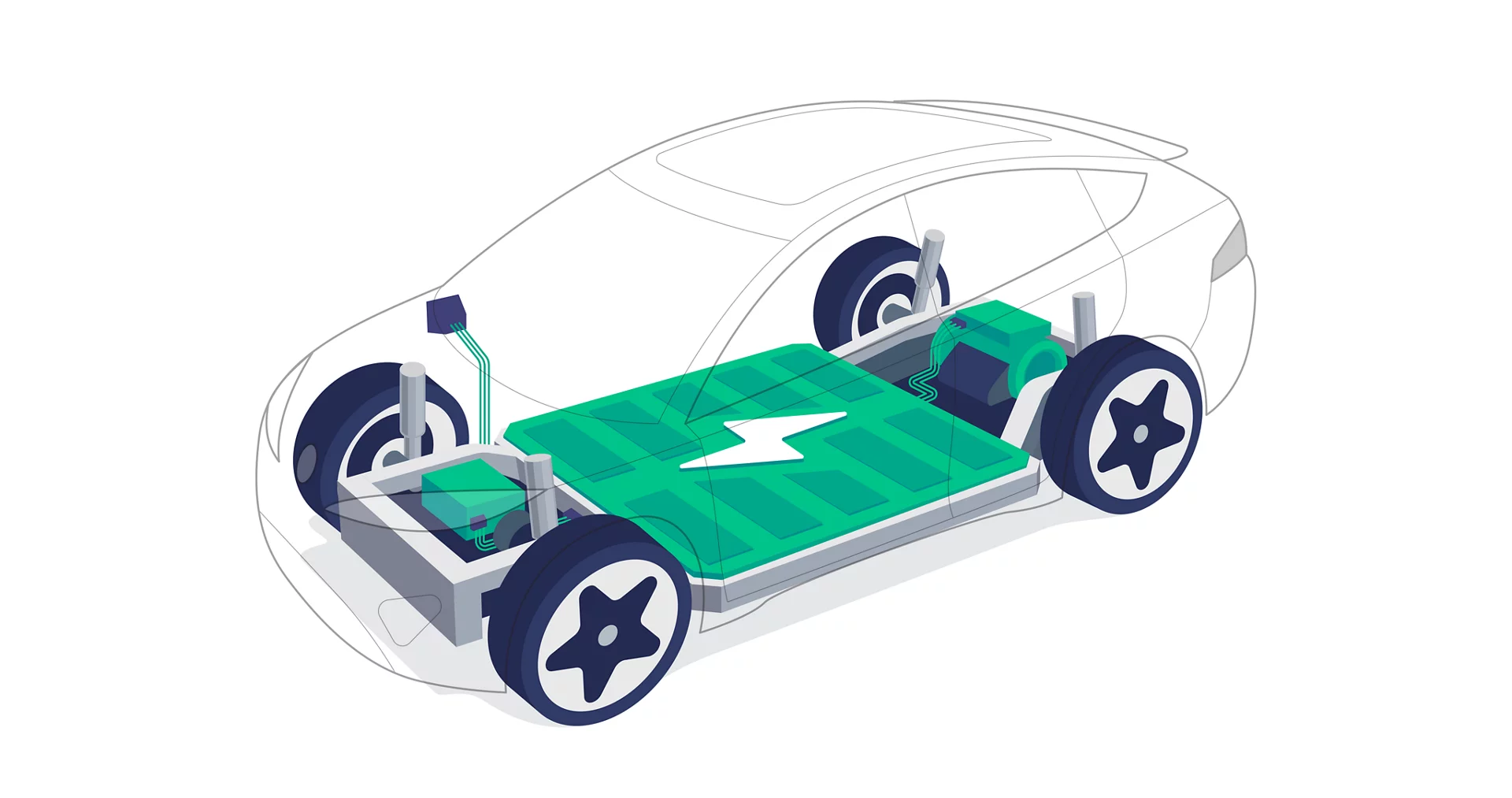
An EV battery pack is made of hundreds or thousands of individual lithium-ion cells, grouped into modules and wired together, plus a battery management system (BMS) that monitors temperature, voltage, and charge balance across every cell. Capacity is measured in kilowatt-hours (kWh) — the total amount of energy the pack can store — which is the closest EV equivalent to a fuel tank's size in gallons or liters.
A high energy-density chemistry that favors maximum range for a given pack size and weight, common in longer-range and premium EVs. It's typically somewhat more sensitive to being kept at 100% charge for long periods than LFP.
A more thermally stable, generally longer cycle-life chemistry that has become common in standard-range and value-focused EVs. It's usually less energy-dense than NMC (so packs can be slightly heavier for the same range), but it tolerates frequent full charging to 100% much better and is generally less expensive to produce.
An emerging next-generation chemistry that replaces the liquid electrolyte with a solid material, promising higher energy density, faster charging, and improved safety. Several automakers and battery makers have announced development programs and early pilot production, but solid-state packs are not yet in mainstream mass-produced EVs.
Like any rechargeable battery, an EV pack gradually loses a small amount of its maximum capacity over time and use — this is normal and expected, not a defect. Degradation is typically fastest in the first year or two and then levels off. LFP packs generally degrade more slowly over high mileage than NMC packs. Frequent DC fast charging, regularly charging to 100% and letting the battery sit there, and extreme heat all tend to accelerate wear somewhat, while charging to around 80–90% for daily use and avoiding prolonged exposure to extreme temperatures helps preserve capacity longer.
Catastrophic failure requiring a full pack replacement is rare, but can be costly outside of warranty, which is why most manufacturers back their battery with a dedicated multi-year, high-mileage warranty separate from the rest of the vehicle's coverage.
Curious how battery size translates to range for a specific model? Browse the Electricarly spec database for battery capacity, chemistry, and rated range.
