
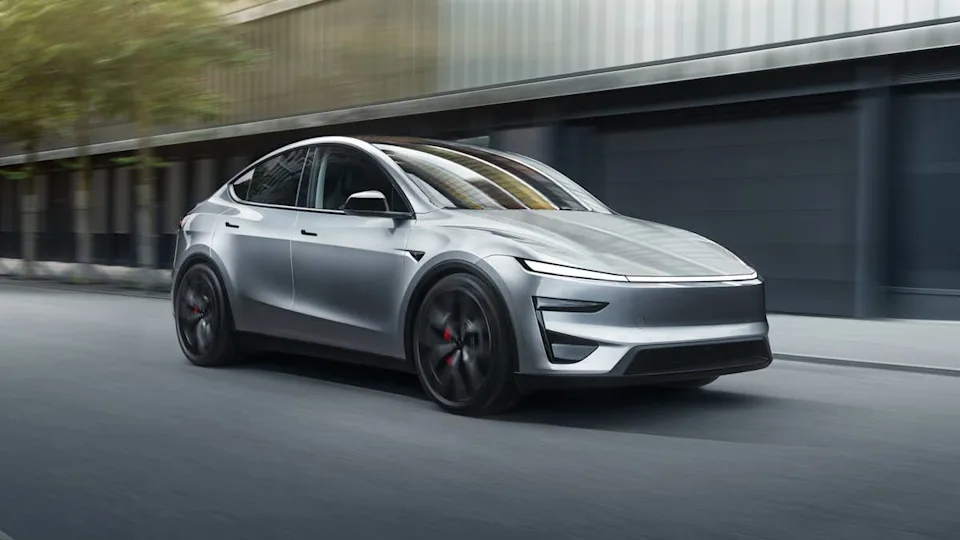
Tesla announced this week that its fleet in Denmark has crossed 100,000 vehicles — a milestone that lands just two weeks before a European Union vote that could open Full Self-Driving (Supervised) to all 27 member states at once.
What the 100,000 Figure Actually Means
Tesla’s Europe, Middle East and Africa account posted the milestone on X on September 23, based on Bilstatistik data. Importantly, the figure covers every Tesla on Danish roads, including used imports — it is not a tally of new-car sales, and Tesla didn’t break it down by model or registration year.
Still, the scale is notable: it puts roughly one in every seven of Denmark’s approximately 700,000 electric vehicles behind the wheel of a Tesla. The company’s Danish fleet stood at just over 84,000 in June 2025, meaning it has grown by close to 20% in a little over a year.
New Registrations Are Running Well Ahead of 2025
The fleet milestone sits on top of genuinely strong new-car momentum. Tesla registered 7,691 vehicles in Denmark from January through August 2026, up 68.7% from 4,558 in the same period last year, according to official Bilstatistik data.
Daily tracking from EU-EVs shows Tesla registered 1,401 vehicles in Denmark between September 1 and 23 — up 32.7% year-over-year — giving Tesla a 12.3% share of Danish electric-car registrations for the period, ahead of Toyota (1,081 units) and Volkswagen (1,073).
Model breakdown tells an interesting story: the Model 3 led with 832 units, up a striking 340.2% year-on-year, while the Model Y came in at 569 units, down 34.4% — likely reflecting the platform refresh and shifting demand as buyers wait for updated stock or consider alternatives like the Skoda Elroq, which ranked third with 441 units.
Combining EU-EVs’ September count with Bilstatistik’s monthly totals puts Tesla’s 2026 Danish year-to-date registrations at an estimated 9,092 units, already within striking distance of the 9,454 Tesla registered in all of 2025 — with more than a week of September still to count.
FSD Approval Came After Growth Was Already Accelerating
Denmark provisionally approved FSD (Supervised) on June 9, 2026, becoming the fourth European country to recognize the Netherlands’ original type approval. Denmark’s road traffic authority, Færdselsstyrelsen, was explicit that the approval does not make the car self-driving.
The timeline is worth untangling carefully, because sales were already surging before that approval:
- January–May 2026: 4,438 registrations, up 79.8% year-over-year
- March 2026: up 144.0% to 1,447 units
- May 2026: up 136.3% to 1,751 units
- June–August 2026 (post-approval): 3,253 registrations, up 55.6% year-over-year — a slower growth rate than the pre-approval months
Because the same period saw the refreshed Model Y, local incentive changes, and weak 2025 comparisons, it’s difficult to credit FSD approval alone for the sales trend. Notably, Electricarly’s sister coverage found that FSD approvals across six EU markets showed no clearly visible sales effect when isolated from other factors.
Tesla also changed how it sells FSD in Denmark: the previous one-time purchase price of DKK 58,300 (about $9,000) was replaced in May with a subscription at DKK 750 ($115) per month, and Tesla ran two-month free trials for owners in approved markets during August.
Tesla’s Best European Sales Week of the Year
Denmark’s strength is part of a broader European surge. According to X-based tracker piloly, Tesla recorded 11,100 sales across ten key European markets in the week of September 14–20 — up 73.5% week-over-week and 101.6% year-over-year. Those ten markets (UK, Norway, Netherlands, Sweden, Denmark, Italy, Spain, Switzerland, Czech Republic, and Iceland) are estimated to represent roughly 60% of Tesla’s total European sales.
Across the first 12 weeks of Q3, sales in those markets were down 6.5% from Q2 but up 7.5% year-over-year, with year-to-date sales up 14.8%.
Supply is scaling to match. Gigafactory Berlin reportedly scheduled mandatory special shifts through September, aiming to lift weekly Model Y output from under 6,500 to 7,500 units by mid-October, according to an internal email reported by Handelsblatt.
The Vote That Actually Matters: October 6
Denmark’s approval is one of seven EU countries — alongside the Netherlands, Lithuania, Estonia, Belgium, Slovenia, and Czechia — that have individually recognized the Dutch RDW’s original FSD (Supervised) certification via mutual recognition rather than independent testing. Combined, these seven represent just under 12% of the EU’s population.
The real prize is a bloc-wide vote expected October 6, 2026, at the European Commission’s Technical Committee on Motor Vehicles (TCMV). Passing requires a qualified majority: at least 15 of 27 member states, representing 65% of the EU’s population. A prior meeting on June 30 ended without a vote.
Ahead of the vote, Tesla published a detailed FSD Supervised safety dashboard on September 1, drawing on roughly 3 billion kilometers of overall Tesla driving in 2025 and about 102 million kilometers of FSD (Supervised) driving across the five (now seven) approved countries. Headline claims include:
- FSD (Supervised) vehicles were involved in 4.1 times fewer crashes than the same Teslas driven manually with Active Safety features on
- Automatic emergency braking activations dropped by up to 84%
- Minor lane-change collisions fell 99% on highways and 93% off-highway, across 377 million fleet manoeuvres
Not every country is convinced. Sweden’s Transport Agency has recommended voting against approval unless Tesla removes a feature that lets drivers set a speed margin above posted limits — though Sweden’s government said September 1 it supports EU-wide approval regardless. France raised similar overspeed concerns but has since begun independent on-road testing of two Tesla-supplied FSD vehicles through UTAC, its national homologation body, with results targeted for readiness ahead of the vote.
Denmark’s own regulator has warned that if the European Commission ultimately rejects bloc-wide approval, the underlying Dutch provisional approval would lapse after six months — and Denmark’s national clearance would lapse along with it.
What to Watch Next
Two dates matter most for anyone tracking Tesla in Europe: September 30, when Q3 European and global sales data will start rolling in, and October 6, when the TCMV vote will either extend FSD (Supervised) to all 27 EU states at once or send Tesla back to the slower, country-by-country approval path it has followed since April.
FAQ: Tesla in Denmark and the EU FSD Vote
Tesla announced on September 23, 2026, that it has 100,000 vehicles on Danish roads, based on Bilstatistik data. The figure includes used imports and is not a new-car sales count.
Which EU countries have approved Tesla FSD (Supervised)? As of September 2026, seven countries have approved FSD (Supervised) through mutual recognition of the Dutch RDW’s original type approval: the Netherlands, Lithuania, Estonia, Denmark, Belgium, Slovenia, and Czechia.
When is the EU vote on Tesla FSD? The European Commission’s Technical Committee on Motor Vehicles is expected to vote on EU-wide approval of FSD (Supervised) on October 6, 2026. Passing requires support from at least 15 of 27 member states representing 65% of the EU’s population.
Did FSD approval boost Tesla’s sales in Denmark? Tesla’s Danish registrations were already growing quickly before its June 9 FSD approval, and growth slowed slightly afterward, making it hard to isolate FSD’s specific impact from other factors like the refreshed Model Y and incentive changes.


2 thoughts on “Tesla Hits 100,000 Cars in Denmark as FSD’s Make-or-Break EU Vote Nears”