
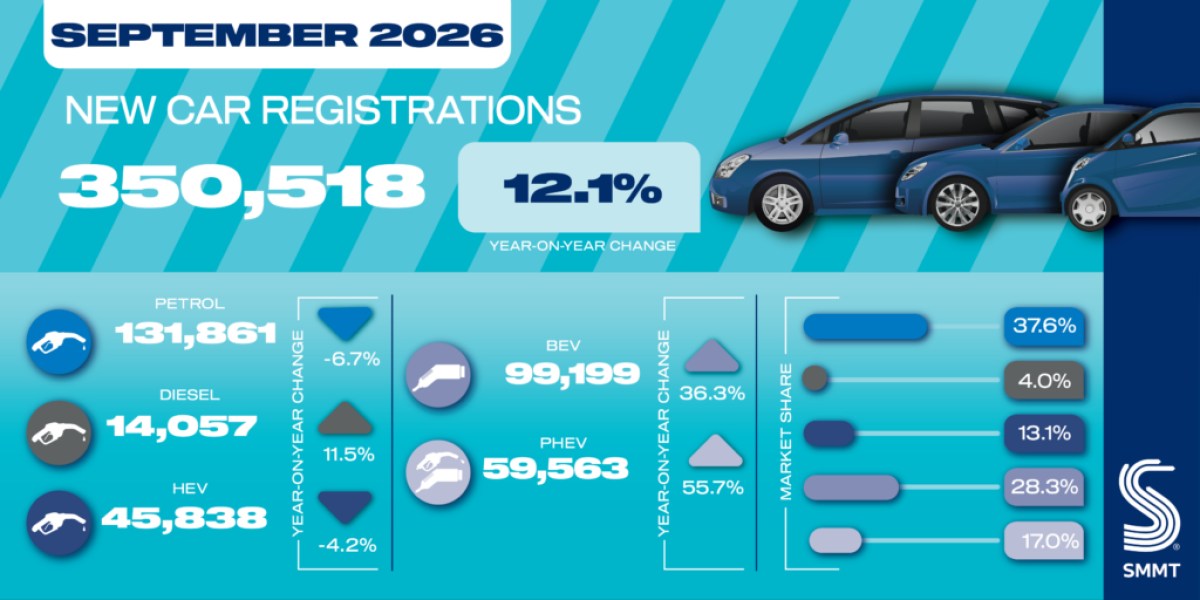
Britain has just recorded its biggest month ever for battery-electric cars. In September 2026, UK drivers registered 99,201 new BEVs, a 36.3% increase on September 2025, according to the Society of Motor Manufacturers and Traders (SMMT). That works out at almost five new electric cars every minute, and it lifted BEVs to a 28.3% share of the new-car market.
Below, we cover who bought them, which models led, what the specs look like, how the Electric Car Grant and the ZEV mandate review fit in, and why public charging prices remain the sore spot.
Key takeaways
- Record month: 99,201 BEVs, up 36.3% year on year, for a 28.3% market share.
- Strongest September since 2017: the total market grew 12.0% to 350,536 cars, the tenth straight month of growth.
- Private buyers are leading: private registrations rose 13.9%, faster than fleets at 9.6%.
- Tesla Model 3 is the best-selling EV, but BYD, Kia and Leapmotor are close behind.
- Plug-in hybrids surged 55.5% to a record 17.0% share.
- The mandate gap is real but contested: year-to-date BEV share is 26.2% against the 33% headline target for 2026, and a government review is open until 23 October.
- Public rapid charging is expensive, at around 77–80p per kWh, against about 7p for off-peak home charging.
UK new car market, September 2026: the numbers
September is the plate-change month and typically delivers around one in seven of the year’s registrations, so it is the market’s biggest stress test. This year the headline figures were:
| Metric | September 2026 |
|---|---|
| Total new car registrations | 350,536 (+12.0%) |
| Battery-electric (BEV) | 99,201 (+36.3%), 28.3% share |
| Plug-in hybrid (PHEV) | Record volume (+55.5%), 17.0% share |
| Full hybrid (HEV) | Down 4.3%, 13.1% share |
| All electrified powertrains | Record 58.4% share |
| BEV + PHEV combined | About 45% of new cars |
Petrol registrations fell by around 6.7%, according to SMMT figures reported by ArenaEV. In other words, nearly all of the market’s growth came from vehicles with a plug.
What drove the UK EV Sales September 2026 record?
The SMMT credits four factors: far more model choice (especially in smaller, cheaper segments), heavy manufacturer discounts, the government’s Electric Car Grant, and high fuel prices nudging people toward electric. The choice point is easy to check. There are now 178 BEV models on sale in the UK, more than double the number in 2023. Together with over 110 PHEVs and around 50 hybrids, electrified cars make up more than three-quarters of all new models.
You can see that range for yourself by browsing our full brand directory, which covers 73 manufacturers and over 1,000 specification sheets.
Private buyers are driving growth, not just fleets
For years the standard criticism was that UK EV growth was a company-car story. September’s data doesn’t support that.
- Private registrations: up 13.9% to 149,166 cars, a 42.6% share
- Fleet registrations: up 9.6% to 190,998 cars, a 54.5% share
- Small-business registrations: up 37.3% to 10,372 cars
Households are putting their own money into EVs, and the growth is strongest where cars are affordable. If you’re deciding whether an EV fits a private budget, start with our cheapest EVs ranking and our best-value EVs list, which ranks models by range per unit of price.
Best-selling electric cars in the UK: September 2026
Tesla Model 3 and Model Y lead again
The refreshed Tesla Model 3 was the UK’s best-selling EV with 9,929 registrations. That also made it Britain’s second best-selling car of any fuel type, behind only the Jaecoo 7. The Tesla Model Y added 5,946, placing fifth overall. Together, Tesla’s two cars made up 15,875 registrations, about 16% of all BEVs sold.
On paper the Model 3 Standard is a strong all-rounder. Our database lists a 69 kWh LFP battery, 225 kW peak DC charging, 11 kW AC charging and a drag coefficient of 0.219 Cd. (The range figure on that page is the US EPA rating, so check the UK WLTP figure before comparing.) For more Tesla context, see all Tesla models and drivetrains, or read our report on Tesla passing 100,000 cars in Denmark.
BYD takes the next two places
BYD’s SeaLion 7 registered 3,191 cars, and the BYD Seal followed with 3,184. The SeaLion 7 Comfort pairs a 230 kW motor with an 82.5 kWh usable LFP battery, a 482 km WLTP range and 10–80% DC charging in about 32 minutes. Browse the rest of the range on our BYD brand page.
Kia EV3: the small crossover that keeps climbing
The Kia EV3 took 3,026 registrations. The Standard Range version has a 58.3 kWh battery, 414 km WLTP range, 150 kW of power and 10–80% charging in 31 minutes, listed from around £33,000. If you want more range, compare it with the EV3 Long Range, or see every model on our Kia brand page.
Leapmotor B10: budget-minded and in the top ten
Stellantis-backed Leapmotor placed the B10 in the top ten with 1,883 registrations. It has a 69.9 kWh LFP battery, 160 kW of power and a 420 km WLTP range. Its 80 kW DC charging rate is slower than the others here, which matters on long trips. See the full Leapmotor lineup.
The Jaecoo 7: an overall number one, mostly as a PHEV
The Chery-built Jaecoo 7 topped the whole market in September. It first became Britain’s best-selling new car in March 2026, the first time a Chinese model had led a UK month, and the large majority of its sales are plug-in hybrids rather than pure EVs. The PHEV offers about 56 miles of electric range, and the model started at around £29,000 for the petrol version at launch. Our Jaecoo brand page currently lists the Jaecoo 5 EV. For a wider look at the Chinese brands taking share, see our ranking of the best Chinese EVs of 2026.
How the September top sellers compare
| Model | Battery | Power | Range (official) | DC charging | Base price in our database |
|---|---|---|---|---|---|
| Kia EV3 Standard Range | 58.3 kWh | 150 kW | 414 km WLTP | 10–80% in 31 min | £33,000 |
| BYD SeaLion 7 Comfort | 82.5 kWh usable | 230 kW | 482 km WLTP | 10–80% in 32 min | £51,000 |
| Leapmotor B10 | 69.9 kWh | 160 kW | 420 km WLTP | 30–80% in 30 min | Not listed |
| Tesla Model 3 Standard | 69 kWh | Rear-wheel drive | 517 km (US EPA) | 225 kW peak | $37,000 (US) |
Prices are manufacturer base figures from our database and exclude grants or dealer discounts. Want to line up any of these side by side? Use our EV comparison tool, or the EV Finder to filter by budget and range.
The Electric Car Grant: why it matters for buyers
The Electric Car Grant (ECG) is a major reason sub-£40,000 EVs are selling. It takes up to £3,750 off qualifying new electric cars at the dealer, with no forms. There are two bands:
- Band 1: £3,750 for models with stronger sustainability credentials
- Band 2: £1,500 for models that meet the basic standard
Eligible cars must come in under the scheme’s price cap (initially £37,000, with higher limits introduced for some models), and the approved list keeps growing. Models that have qualified for the full grant include the Renault 5 and Renault 4, Nissan Leaf and Micra, Ford Puma Gen-E, Citroën ë-C5 Aircross and Mini Countryman. BMW’s single-motor iX1 and iX2 eDrive20 versions joined the top tier on 24 July 2026, and Kia has secured full-grant status for some EV2 and EV4 variants.
Because eligibility varies by exact trim, always confirm against the official GOV.UK list before ordering. To compare grant-eligible models on specs, browse Renault, Nissan, Ford, Citroën, BMW and Mini on Electricarly. If you’re shopping at the lower end, see which ones are also in our most efficient EVs list, since low consumption cuts your running costs.
The plug-in hybrid boom: popular, but under scrutiny
PHEV registrations jumped 55.5% to a record 17.0% share. For buyers worried about charging, a PHEV offers short electric trips with petrol as a backup. The trade-off is complexity: two powertrains, extra weight, and poorer efficiency once the battery is empty.
Policymakers have noticed. The government’s ZEV mandate review is examining what it calls the “PHEV loophole”, where a utility-factor flexibility lets manufacturers offset zero-emission targets using hybrid sales. If rules change in carmakers’ favour, showrooms could shift further toward plug-in hybrids and away from pure EVs. If the rules tighten, expect more emphasis on BEVs. Either way, check the real-world electric range of any PHEV you consider, and compare it against a pure EV in our longest range ranking.
The ZEV mandate: record sales, but a gap to the target
The ZEV mandate requires manufacturers to sell a rising share of zero-emission vehicles each year: 28% in 2025 and 33% in 2026.
The SMMT’s position is that BEV share is 26.2% year to date (454,947 cars), below both targets. On its projected 2.183 million-car market, hitting 33% would take roughly 265,000 more BEVs in the final three months of the year. SMMT chief executive Mike Hawes argues that the UK has the world’s toughest targets and the highest energy costs, and he wants the review to reflect that.
The counter-argument is that the headline number overstates the burden. Manufacturers can bank and borrow credits, convert CO2 over-performance into ZEV credits, and trade with other makers. Analysts at New AutoMotive, as cited by ArenaEV, estimate the effective 2026 threshold is closer to 24.6%. The government said in August that manufacturers were on track for their 2026 targets.
Where the review stands
- 14 August 2026: the government opened a consultation on the ZEV mandate.
- 23 October 2026: the consultation closes.
- Early 2027: the government aims to complete the review and announce any changes.
The 2030 phase-out of new petrol and diesel cars remains official policy, but the review is looking at whether annual targets should be softened and whether flexibilities should change. Charging firms, fleets, battery makers and environmental groups have urged ministers to hold the line, while the SMMT welcomes a rethink. The outcome will shape prices, discounts and model availability.
Public charging: the weak link
Here the industry has a fair point. Charging at home is cheap, but public rapid charging is not.
| Where you charge | Typical price per kWh |
|---|---|
| Home, off-peak EV tariff | About 7p |
| Home, standard rate (Ofgem cap, Jul–Sep 2026) | 26.11p |
| Public slow/fast (3–49 kW) | About 54p |
| Public rapid/ultra-rapid (50 kW+) | About 77–80p |

Two factors explain much of the gap. Public charging carries 20% VAT, against 5% for domestic electricity, and rapid-charger operators face high commercial power costs. Across the ten biggest rapid networks, pay-as-you-go prices in August 2026 ranged from 59p to 92p per kWh.
What a charge actually costs
Using our database figures, here is an approximate cost for two September best-sellers (before charging losses):
| Kia EV3 Standard Range | BYD SeaLion 7 Comfort | |
|---|---|---|
| Full home charge, off-peak (7p) | ≈ £4.10 | ≈ £5.80 |
| Full home charge, standard (26.11p) | ≈ £15.20 | ≈ £21.50 |
| Rapid 10–80% at about 77p | ≈ £31.40 | ≈ £44.50 |
| Approx. cost per mile at 7p / 26.11p / 77p | 1.8p / 6.6p / 19.6p | 2.2p / 8.4p / 24.7p |
The takeaway is simple: home charging on an off-peak tariff is where EVs save serious money. If you rely on public rapid chargers for everything, an EV can cost as much to run as a petrol car. That is why charging access should be part of any buying decision. Check charging speeds in our fastest-charging EVs ranking, and see which cars have the biggest batteries if you do long motorway runs.
What this means if you’re buying an EV
- Set a budget and check grant eligibility first. Start with the cheapest EVs list, then confirm the model and trim on GOV.UK.
- Match range to your real driving. Official WLTP figures are lab ratings, and winter motorway driving will usually return less. Compare candidates in our range ranking.
- Plan your charging. Home charger plus an off-peak tariff is the strongest running-cost case. If you can’t charge at home, price your typical public charges honestly.
- Don’t ignore charging speed. A 150 kW car and an 80 kW car behave very differently on a road trip.
- Compare before you commit. Put your shortlist side by side in the compare tool or search the whole database with our model search.
- Watch the review. Changes to the mandate could affect future discounts, so factor in your timing.
Outlook: what to watch in Q4 2026
- 23 October: ZEV mandate consultation closes.
- Early November: the SMMT publishes October registrations, a test of whether September’s momentum holds outside plate-change season.
- Q4 BEV share: the gap to the 33% target will be clearer by year-end.
- Early 2027: the government’s review outcome.
For the latest launches and EV news as they happen, follow our News & Updates section, and browse the newest EVs on sale.
FAQs
How many electric cars were registered in the UK in September 2026?
A record 99,201 battery-electric cars, up 36.3% on September 2025, giving BEVs a 28.3% share of the new-car market.
What was the UK’s best-selling EV in September 2026?
The Tesla Model 3, with 9,929 registrations.
Is the UK meeting its 2026 ZEV mandate target?
Not on headline BEV share. Year-to-date it is 26.2%, against a 33% target. Compliance flexibilities lower the effective requirement, and the government says manufacturers are on track.
How much is the Electric Car Grant?
Up to £3,750 off eligible new EVs, or £1,500 for models in the lower band, applied at the dealer. Check the official GOV.UK list for current eligibility.
Why is public charging so expensive in the UK?
Mainly 20% VAT (versus 5% at home), high commercial electricity costs and operator charges. Public rapid chargers average roughly 77–80p per kWh, compared with around 7p for off-peak home charging.
When will the ZEV mandate review conclude?
The consultation closes on 23 October 2026, and the government aims to complete the review by early 2027.
Specifications are manufacturer-published figures and may vary by market and trim. Always confirm pricing and eligibility with the manufacturer or dealer before buying.
Sources: SMMT, September 2026 registrations · ArenaEV analysis · GOV.UK, ZEV mandate review · Browne Jacobson, review analysis · Carwow, review explainer · Carsa, UK charging costs


2 thoughts on “UK EV Sales September 2026: Record 99,201 Electric Cars”